Social Justice and Social Security Committee
Annual Report of the Social Justice and Social Security Committee 2025-26
Infographic Summary
Scottish Parliament
Introduction
This report outlines the work of the Social Justice and Social Security Committee (“the Committee”) during the Parliamentary year from 13 May 2025 to 8 April 2026.
The Committee looks at subjects such as:
the Scottish Government's policies on welfare and poverty
the social security system in Scotland
homelessness and rough sleeping
fuel poverty and debt advice services
violence against women and girls and domestic violence
social justice (looking at ways to create a fairer Scotland)
the third sector including social economy and the Office of the Scottish Charity Regulator (OSCR)
There were several changes to the Committee's membership during the Parliamentary year:
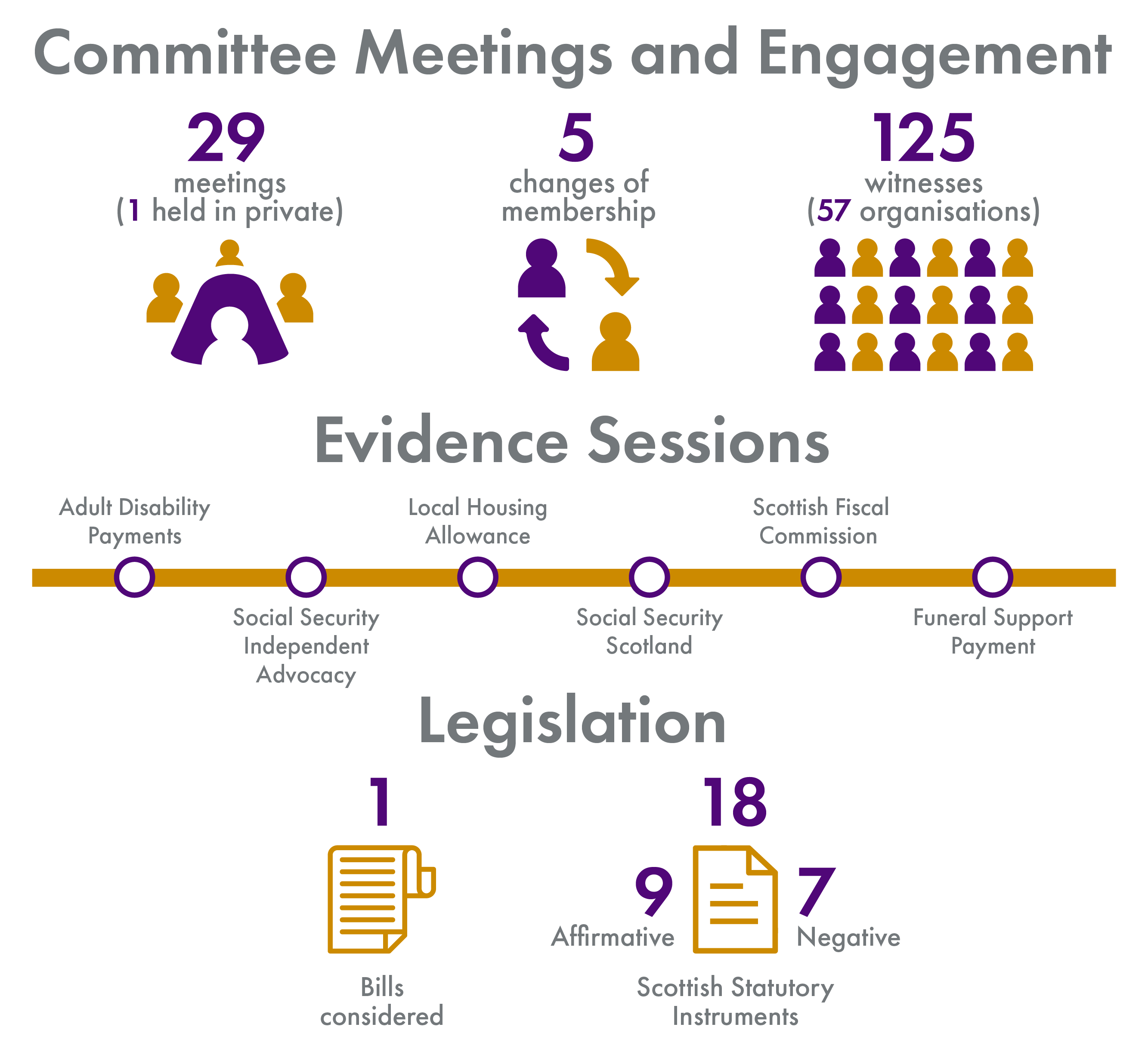
On 19 June 2025, Elena Whitham replaced Gordon MacDonald as a member of the Committee
On 26 June 2025, Alexander Stewart replaced Liz Smith as a member of the Committee
On 2 September 2025, Carol Mochan replaced Mark Griffin as a member of the Committee
On 2 September 2025, Michael Marra replaced Paul O’Kane as a member of the Committee
On 10 December 2025, Claire Baker replaced Michael Marra as a member of the Committee
Meetings
During the Parliamentary year, the Committee held 29 meetings. Of these, one was held entirely in private, with the remaining 28 meetings including a mixture of public and private items. The reasons for taking business in private were to consider the Committee's work programme, draft reports or letters, or to consider the evidence heard earlier in public, during the same committee meeting.
Of the 29 meetings held this year, 2 of these were held as joint meetings. The Committee held a joint meeting with the Health, Social Care and Sport Committee and the Criminal Justice Committee on 2 October 2025, and a joint meeting with the Health, Social Care and Sport Committee on 12 February 2026. Both joint meetings were held partly in private (to review evidence heard, in public, earlier in the meeting).
The Committee heard from 125 witnesses. These witnesses represented 57 different organisations.
Legislation
The Committee has considered 1 Bill and 17 items of subordinate legislation during this reporting year.
Bills
Wellbeing and Sustainable Development (Scotland) Bill
The Member's Bill was introduced by Sarah Boyack MSP on 27 March 2025. Its purpose was to compel public bodies to take account of the need to promote wellbeing and sustainable development in their work. The Bill also sought to establish a Future Generations Commissioner, to help promote the wellbeing of future generations and sustainable development. The Committee acted as the lead committee for Stage 1 scrutiny of the Bill.
The Committee published its Stage 1 report on the Wellbeing and Sustainable Development (Scotland) Bill on 19 December 2025. The Committee supported the policy objectives of the Bill, however, on balance, a majority of the Committee concluded that the Bill should not proceed to Stage 2, with a minority of the Committee feeling there was a strong argument for the Bill to proceed to Stage 2.
The Bill fell at Stage 1 on 22 January 2026.
Scottish Parliament
Subordinate legislation
Consideration of regulations forms an important part of the Committee's work. The Committee considered 17 Scottish Statutory Instruments during this reporting year (9 affirmative, 8 negative).
LCMs
During the reporting year, the Committee considered two Legislative Consent Memorandums, lodged in relation to the Public Authorities (Fraud, Error and Recovery) Bill and the Armed Forces Bill.
For the Public Authorities (Fraud, Error and Recovery Bill) the Committee took evidence from the Cabinet Secretary for Social Justice and recommended to Parliament that consent is given for the relevant provisions in the Bill. The Committee's report was published on 19 June 2025.
For the Armed Forces Bill, the Committee took evidence from the Minister for Parliamentary Business and Veterans and recommended to Parliament that consent is given for the relevant provisions in the Bill. The Committee's report was published on 18 March 2026.
Inquiries/case studies
Case study 1 - Inquiry into financial considerations when leaving an abusive relationship
The Committee's inquiry into financial considerations when leaving an abusive relationship began in December 2024.
Evidence sessions covered themes such as third sector support, housing and homelessness, financial support for victims and survivors, legal aid, social security and public debt.
Following its scrutiny of evidence, the Committee met with members of Scottish Women's Aid’s Survivor Reference Group (SRG) on 11 June 2025, to hear their views on the evidence received, with a view to compiling conclusions and recommendations.
The Committee published its report on its findings on 9 July 2025. In its response the Scottish Government pledged the provision of £608,559 in 2025/26 to Scottish Women's Aid to deliver the Scottish Domestic Abuse and Forced Marriage Helpline, alongside other measures across the Committee's recommendations.
Case study 2 - Tackling drug deaths and drug harm cross-committee
As part of a joined-up approach to tackling problem drug use, the Criminal Justice, Health, Social Care and Sport, and Social Justice and Social Security Committees have met jointly since February 2022 to consider the efforts being made to tackle drug deaths and reduce drug harm. This approach reflects the need to consider aspects of the criminal justice system, as well as health policies and wider social and economic matters such as poverty, unemployment, unstable housing, and family breakdown.
Members of the three committees commissioned a People’s Panel to consider the question – ‘What does Scotland need to do differently to reduce drug related harms?’.
During the reporting period, the three committees heard evidence from stakeholders involved in The Thistle, the safer drug consumption facility pilot in Glasgow, in addition to the Minister for Drugs & Alcohol Policy and Sport.
The cross-committee’s legacy report was published on 6 March 2026. To support the report, the committees issued a stakeholder feedback survey, inviting feedback from MSPs, witnesses, People's Panel members and other stakeholders in order to inform future parliamentary scrutiny and committee collaboration.
Pre-budget scrutiny
For the Committee's pre-budget scrutiny 2026-27, members focused on the forecasted social security spend in the context of the Scottish budget as a whole.
The Committee asked the Scottish Government to set out how it intends to fund its programme of devolved social security across the wider resource budget and called for greater clarity on the choices required to manage rising demand-led expenditure while maintaining investment in anti-poverty measures.
In its response to the Committee's report, the Scottish Government confirmed that social security investment will rise to £7.2 billion in 2026-27 and emphasised that this is fully funded, highlighting updated Scottish Fiscal Commission forecasts which significantly reduce the additional resources required to maintain its programme of devolved social security.
Thematic Evidence Sessions
Adult Disability Payment
At its meeting on 18 September 2025, the Committee agreed to schedule two evidence sessions on Adult Disability Payment (ADP).
On 27 November 2025, Members heard from two panels of witnesses. The first panel featured Edel Harris OBE, Former Chair of the Independent Review of Adult Disability Payment. This review considered the effectiveness of ADP in meeting the needs of disabled adults. The second panel focused on Audit Scotland's Adult Disability Payment report.
Following the publication of the Scottish Government's response to Edel Harris's review, Members agreed to hold an evidence session with members of Edel Harris's advisory group. The Committee subsequently heard evidence from SAMH, Citizens Advice Scotland, Enable Scotland and MS Society.
Social Security Independent Advocacy Service
On 11 December 2025, the Committee took evidence from Advice Direct Scotland (ADS), the newly appointed contractor for the Social Security Independent Advocacy Service.
Following the evidence session, the Committee agreed to recommend in its Session 6 legacy report that its successor Committee should review the progress of the work carried out by ADS in its delivery of the contract.
UK Child Poverty Strategy
Following the publication of the UK Government's Child Poverty Strategy on 5 December 2025, the Committee heard from the Cabinet Secretary for Social Justice on the impact that the removal of the two-child cap would have on Scotland's social security system.
The UK Government provided written evidence following the session, as they were unable to attend.
Local Housing Allowance
At its meeting on 8 January 2026, the Committee held two evidence sessions on the Local Housing Allowance. As part of its inquiry, the Committee heard from a panel of representatives from local authorities, followed by a panel consisting of organisations supporting applicants.
Members agreed to include in the legacy report the issues raised in evidence, including the gap between LHA and rents and the impact on local authorities in covering the additional costs.
Social Security Scotland
Social Security Scotland plays a crucial role in administering devolved benefits in Scotland, with a mandate to uphold principles of dignity, fairness and respect, as outlined in the Social Security (Scotland) Act 2018.
The Committee held an evidence session with Social Security Scotland on 22 January 2026 on its performance and operation.
Scottish Fiscal Commission
The Committee held an evidence session with representatives of the Scottish Fiscal Commission on 29 January 2026, as part of its scrutiny of the Scottish Government's budget for 2026-27.
The Committee considered the Scottish Fiscal Commission's latest five-year forecast of social security expenditure up to 2030-31.
Funeral Support Payment
At its meeting on 22 January 2026, the Committee agreed to hold a roundtable evidence session on issues surrounding the Funeral Support Payment.
The Committee held a roundtable evidence session on 19 February 2026. The session covered the benefit's low rate of take-up, the administrative issues surrounding the payment and its impact on both funeral directors and applicants.
Job Start Payment
At its meeting on 22 January 2026, the Committee agreed to hold a roundtable evidence session on the Job Start Payment.
The Committee held a roundtable evidence session on 5 March 2026. The session covered support for young people seeking employment, and improving authorisation and application rates for the Job Start Payment, with contributions from Social Security Scotland, Skills Development Scotland, the Scottish Throughcare and Aftercare Forum, and The King's Trust.
Equal opportunities
The work of the Committee is rooted in equalities. Through its work the Committee looks to hear from a diverse range of people and lived experiences when taking evidence. It therefore asks organisations to consider this when identifying people to speak to us.
For example, as part of its scrutiny of the Wellbeing and Sustainable Development (Scotland) Bill, the Committee heard from Members of the Scottish Youth Parliament, Carnegie UK, the Children and Young People’s Commissioner Scotland and Scottish Environment LINK.
As part of its pre-budget scrutiny, focusing on the forecasted social security budget spend, the Committee heard from a range of representative organisations including the Joseph Rowntree Foundation, the Poverty and Inequality Commission, Citizens Advice Scotland, One Parent Families Scotland, Age Scotland, Carers Scotland, and the Health and Social Care Alliance Scotland.
All these sessions have proved immensely valuable in enabling the Committee to better understand the issues from those with real life experiences. We are grateful to all who took part in these sessions.
Visit
As part of the Committee's scrutiny of Social Security Scotland, Members visited the agency's offices in Glasgow to hear how it is managing the closure of the programme that oversaw the transition of benefit administration from the DWP, including its approach to capacity and to addressing fraud and error.

Scottish Parliament