Equalities, Human Rights and Civil Justice Committee
Legacy Report of the Equalities, Human Rights and Civil Justice Committee, Session 6
Introduction
This report summarises the work undertaken by the Equalities, Human Rights and Civil Justice Committee in Session 6. It is not an exhaustive account of the work undertaken by the Committee, but instead focusses on key themes emerging from the Committee's work this session, which it strongly recommends its successor committee should pursue next session.
The report, while not providing a definitive account of the Committee's work this session, does list all of the significant pieces of work undertaken by the Committee, the key recommendations and conclusions of that work and the Scottish Government's response to it, where appropriate.
The report also reflects on ways in which the Committee has worked and makes suggestions for approaches to scrutiny that a future committee may wish to adopt.
Overview of Session 6
Full details of the Committee's work each year can be found in its annual reports. This section of the report provides a brief overview of all the work undertaken by the Committee.
Later in this report we consider in more detail those aspects of the Committee's work which we would recommend that a successor committee pursue further next session.
Bills considered by the Committee
The Committee considered eight Bills during Session 6 , as set out in Table 1 below. Six of these were Scottish Government Bills, with the other two being Members’ Bills.
| Bill | Main purpose | Date passed by the Parliament |
| Miners' Strike (Pardons) (Scotland) Bill | The Bill provides a pardon for miners who were convicted of certain offences relating to the 1984-1985 miners’ strike where the conditions of the pardon are met. | 16 June 2022 |
| Gender Recognition Reform (Scotland) Bill | The Bill changes the process to get a gender recognition certificate (GRC). A GRC is a certificate that legally recognises that a person’s gender is not the gender that they were assigned at birth, but is their “acquired gender”. | The Parliament passed the Bill on 22 December 2022.On 17 January 2023, the Secretary of State for Scotland (Alister Jack) made an Order under section 35 of the Scotland Act 1998 preventing the Presiding Officer from submitting the Bill for Royal Assent. This means that the Bill cannot become law in its current form. |
| United Nations Convention on the Rights of the Child (Incorporation) (Scotland) Bill | The Bill incorporates the United Nations Convention on the Rights of the Child (UNCRC) into the law in Scotland. | The Bill was introduced to Parliament last session on 1 September 2020. After the Bill was passed in session 5, it was referred by the Law Officers to the Supreme Court under Section 33 of the Scotland Act 1998. The Supreme Court then ruled that some of the things the Bill set out to do were not within the powers of the Scottish Parliament. The Bill as passed at Stage 3 could therefore not be sent for Royal Assent.On 14 September 2023, the Committee agreed to re-consider the Bill. The Committee considered the Bill and the proposed amendments to it. Parliament approved the amended Bill on 7 December 2023. |
| Gender Representation on Public Boards (Amendment) (Scotland) Bill | The Bill removes the definition of “woman” from the Gender Representation on Public Boards (Scotland) Act 2018. | The Bill was passed on 20 June 2024. |
| Regulation of Legal Services (Scotland) Bill | This Bill updates the regulation of legal services in Scotland and provides for a modernised regulatory framework. | The Bill was passed on 20 May 2025. |
| Disability Commissioner (Scotland) Bill | The Bill sought to establish a Disability Commissioner for Scotland. | The Bill was withdrawn on 30 September 2025. |
| Children (Withdrawal from Religious Education and Amendment of UNCRC Compatibility Duty)(Scotland) Bill | The Bill changes the process for withdrawing pupils from religious instruction or religious observance at school. It also changes how the compatibility duty on public authorities in the United Nations Convention on the Rights of the Child (Scotland) (Act) 2024 operates if there are conflicting statutory duties. | The Bill was passed on 18 February 2026. |
| Commissioner for Older People (Scotland) Bill | The Bill sought to establish a Commissioner for Older People for Scotland. | The Bill was referred to this Committee. The Committee issued a call for views. The responses can be found here. The Committee, however, agreed at its meeting on 9 September 2025 not to undertake any further work on the Bill. |
Other legislative work
Post-legislative scrutiny
A key element of effective scrutiny is ensuring that legislation passed by this Parliament is having its desired effect.
To that end, the Committee undertook post-legislative scrutiny of the British Sign Language (Scotland) Act 2015. The ambitions of the Act were to improve the lived experience of BSL users in Scotland. Ten years on from the Bill receiving Royal Assent, the Committee returned to reflect on whether the Act had realised its ambition.
Later in this report the Committee reflects in more detail on the inquiry, the conclusions of the report and those aspects of it that we would recommend a successor committee follow-up on.
Furthermore, the Committee wishes to stress how important it was that this inquiry was led by the experience of BSL users. In this area of work as with other areas of its work, the Committee felt it was most effective when focussing on lived experience.
As well as undertaking post-legislative scrutiny of legislation that had been implemented the Committee also reflected on the non-implementation of legislation. Specifically, the Committee reflected on the delay in implementation of all or some provisions within the following three Acts:
A number of these provisions continue to be outstanding and we return to this issue in the context of issues that we consider should be pursued next session.
Subordinate legislation
Over the course of this session, the Committee considered 78 instruments.
The majority of those instruments related to the civil justice element of the Committee's remit. Later in this report we reflect on the Committee's work in relation to civil justice and, more specifically, the limited progress in the reform of civil legal assistance this session.
EU Law Tracker
The Scottish Parliament's Constitution, Europe, External Affairs and Culture Committee has commissioned reports this session to support scrutiny by parliamentary committees into the commitment on the part of the Scottish Government to align with European Union (EU) law, as appropriate, following and notwithstanding the withdrawal of the United Kingdom (UK) from the EU.
The sixth report was published in January 2026. The Convener of the Constitution, Europe, External Affairs and Culture Committee wrote to this Committee highlighting alignment with The EU Disability and Parking Cards Directive (EU) 2024/2841 and suggesting that the Committee may wish to write to the Scottish Government on alignment.
The Directive establishes the European Disability Card and the European Parking Card for people with disabilities.
The European Disability Card and the European Parking Card will serve as proof of rights to parking conditions and facilities reserved for people with disabilities, holders of the card, in all EU countries. It will also contain security features to prevent and combat fraud.
The Committee has previously written to the Scottish Government seeking updates on alignment.
To date, the Scottish Government in its responses has not indicated that it intends to pursue alignment, but it has indicated that it is committed to ensuring that the policies that it creates within the Scottish Government follow the social model of disability, where the overarching aim is to dismantle barriers to ensure that disabled people flourish within society.
The Committee urges its successor Committee to follow-up on alignment with this Directive next session.
Inquiries
Listed below are all the inquiries undertaken by the Equalities, Human Rights and Civil Justice Committee during this session. In each case a short summary is provided of the main purpose of the inquiry, key recommendations and the Scottish Government's response.
| Inquiry | Main purpose | Key recommendations and SG response (where available) |
| End Conversion Therapy | The inquiry emerged out of petition PE1817, which called on the Scottish Parliament to urge the Scottish Government to ban the provision or promotion of LGBT+ conversion therapy in Scotland. | The Committee expressed support for the banning of conversion practices.In response the Scottish Government committed to bring forward legislation as far as is practical within the powers available to it by the end of 2023, and the establishment of an Expert Advisory Group on Conversion Practice to inform the development of such legislation.This legislation has not been introduced this session. |
| Women's unfair responsibility for unpaid care and domestic work | The Committee agreed to undertake this inquiry following evidence it received as part of its pre-budget scrutiny. Members heard that the burden placed on women in relation to unpaid caring duties for elderly parents and children and an increase in domestic work during lockdown, and as the country emerged from the pandemic, was considered likely to have a long-term negative impact on their future rights and economic prospects. | The following key conclusions emerged out of the Committee's inquiry:
|
| Asylum Seekers | The Committee undertook an inquiry on asylum seekers in Scotland. While housing asylum seekers is a reserved matter, the Committee wanted to understand:
| The Committee’s recommendations focussed on ensuring safe housing, better access to services, improved legal and rights-based support, fair transport access, and stronger protection for vulnerable groups, while urging the Scottish Government to proactively use devolved powers to counteract the effects of UK‑wide immigration legislation.In its response, the Scottish Government emphasised its opposition to the Illegal Migration Act 2023 and warned of its impacts on devolved areas such as trafficking support and care for unaccompanied children. The Scottish Government stressed ongoing pressures on services, and continued engagement with the Home Office on asylum processes, funding, dispersal and safeguarding. In its response the Scottish Government also highlighted support measures including free bus travel plans, third‑sector resourcing, mental health work, and development of the Scottish Human Rights Bill. |
| HIV Treatment and Awareness in Scotland | The Committee undertook an inquiry to consider progress that has been made with the treatment of HIV in Scotland. | The Committee urged the Scottish Government to introduce mandatory, high‑quality training across health and public services to tackle HIV‑related stigma; expand the anti‑stigma campaign into a broader, culturally sensitive public awareness effort; ensure rural and underserved groups can access services such as e‑PrEP and confidential care; improve HIV education in schools; monitor and report progress on the HIV Transmission Elimination Delivery Plan; evaluate opt‑out testing pilots; widen equitable access to PrEP; and strengthen national HIV data to better target interventions and track progress toward eliminating new transmissions by 2030.In its response the Scottish Government confirmed its commitment to eliminating HIV transmissions by 2030, highlighting ongoing work to expand stigma‑reduction training, improve rural access through online testing and e‑PrEP, consider widening the anti‑stigma campaign, support RSHP education that can include HIV awareness, evaluate opt‑out testing pilots, widen PrEP access through primary care and pharmacies, and strengthen national HIV data and monitoring. |
| Suicide prevention in Scotland | The Committee undertook an inquiry into the Scottish Government and COSLA’s Suicide Prevention Strategy for 2022-2032. | The Committee recommended that the Scottish Government strengthen its suicide prevention efforts by ensuring sufficient, sustained funding for the Creating Hope Together strategy; improving support for high‑risk groups—including men, LGBTQ+ people, those in poverty, rural communities, and people leaving prison or acute mental‑health care; enhancing early intervention through better access to community‑based and immediate support services; expanding and stabilising funding for third‑sector organisations and community link workers; improving training for frontline staff, including prison staff; and addressing major data gaps by enhancing timely access to primary‑care and multi‑agency data to better identify those at risk and monitor outcomes.The Scottish Government and COSLA jointly responded to the Committee’s report reaffirming that suicide prevention is a national priority supported by the Creating Hope Together strategy. They outlined ongoing progress, including strengthened partnerships, a focus on tackling inequalities, investment in community and clinical support, and targeted work with high‑risk groups. The response also highlighted advances such as expanded peer support, improved services, national delivery structures and evaluation tools, while acknowledging challenges around resources, stigma, rural isolation, vulnerable populations, and sustainable funding. |
| Operation of the Public Sector Equality Duty in Scotland | The Committee carried out an inquiry into the operation of the Public Sector Equality Duty in Scotland.Specifically, the Committee looked at:
| The Committee’s reportcalled for fundamental reform of how the Public Sector Equality Duty operates in Scotland, urging the Scottish Government to provide stronger leadership, clearer direction and sustained investment so the duty becomes a real driver of equality rather than a tick‑box exercise.The response from the Scottish Government stressed the importance of fostering good relations, tackling discrimination, strengthening public bodies’ understanding of the duty, and embedding equality across government through new mainstreaming strategies, toolkits and improvement plans. |
| Civil Legal Assistance | The Committee's inquiry emerged out of concerns about access to justice. The Committee wanted to find out what is working and not working within the current civil legal assistance system and what changes could be made in the short and longer term to address access issues. | The Committee expressed immense disappointment in the failure by the Scottish Government to introduce legislation this session to reform civil legal assistance. The Committee highlighted the prevalence of geographical and subject area legal aid deserts. The Committee pressed for increased fees for solicitors and the removal of administrative burdens to ensure increased availability of legal aid representation.The Minister for Victims and Community Safety statedthat the Scottish Government agrees long‑term structural change is needed and noted that it is already progressing simplification of the current system, fee reform, and extensive stakeholder engagement to develop a modern, accessible model of legal assistance. |
| Rurality | This session, the Committee has heard about significant issues of inequality in rural settings. The Committee agreed to undertake a short inquiry looking at rurality in the context of:
| The Committee's reporthighlighted the interconnected nature of many of the additional barriers faced by people living in rural communities. While specifics will vary depending on locality, the report noted an increased cost of living and a lack of affordable housing in many rural communities. Other inequalities related to access to healthcare, education, employment, training, justice and legal advice, all of which can help accelerate depopulation and risk the sustainability of communities.The Committee found that local people were often best placed to come up with local solutions and called for sustainable and secure long-term investment for third sector partners to support their essential work. |
| Neurodivergence | The Committee's inquiry focussed on the experience of neurodivergent people in:
| In its report, the Committee recognised the significant challenges presented by the unprecedented numbers seeking assessments. The Committee stressed that there was a need for long term funding and planning to respond to the challenges and ensure people are able to get life changing diagnoses and post diagnostic support. The Committee also stressed the need to get diagnosis and support right as early as possible, so that neurodivergent people can thrive in education and the workplace. The Committee also argued for a cultural change, so that neurodivergence is celebrated and not seen as a deficit. |
Other scrutiny work
The majority of the Committee's time this session has been focussed on consideration of primary legislation and undertaking its own inquiries. The Committee has, however, also dedicated a significant proportion of its time to budget scrutiny and to a lesser extent to scrutiny of petitions.
This section of the report reflects on the work the Committee has undertaken on the budget and in relation to petitions.
Annual budget scrutiny
The Committee has taken a session-long approach to pre-Budget scrutiny, with a focus on human rights budgeting. This has been a progressive process, starting with a broad look at the concept before moving towards an in-depth focus on the three-principles of human rights budgeting - participation, transparency, and accountability.
Using human rights framing has not only proven a useful structure for a long-term approach, it has also provided an impetus and opportunities for innovation and piloting new approaches to engagement.
Our work on pre-Budget scrutiny also gave us the opportunity to collaborate with professional stakeholders and academics, including through a fellowship with a researcher from the Fraser of Allander Institute (who themselves worked closely with third sector stakeholders), and through co-delivery of a scrutiny workshop with the SHRC.
Taking a human rights-based approach and exploring a citizen perspective helped to demonstrate the cross-cutting impacts of budget decisions and facilitate cross-committee evidence-gathering.
While the Committee’s work might not have resulted in a radical shift in how the Scottish Government has approached human rights budgeting this session, the Committee believes that the process has been an effective one and one that it hopes will bear fruit next session.
Notwithstanding this positivity about the process, it remains immensely disappointing that the Scottish Government’s progress toward a human rights budgeting model has been so slow. Indeed, it is very difficult to identify much in the way of tangible progress.
The Committee urges the Scottish Government to re-double its efforts to move to this model and recommends that its successor committee maintain this approach and hold the Scottish Government to account on progress towards a human rights budgeting model.
Specifically, the Committee urges its successor committee to hold the Scottish Government to account on:
Meeting the recommendations of the Equality and Human Rights Budget Advisory Group
Improving data collection to inform policy making and budget allocation, and to understand the outcomes of spending decisions.
Improving transparency in budget documents with an emphasis on a more joined up approach between the budget, the Programme for Government and the National Performance Framework.
Ensuring meaningful public engagement by the Scottish Government in the development and evaluation of policy.
Fundamentally, in setting its budget, the Scottish Government must move to a much more joined up model across Government that is focused on improving outcomes. We urge our successor committee to press the next administration to achieve that.
Petitions
The Committee has considered two petitions in the course of session 6. As mentioned earlier, the Committee's consideration of Petition PE1817 led to an inquiry into the ending of conversion therapy.
The Committee also considered petition PE1787 on the use of Makaton sign language in the legal system.
The Committee agreed to close the petition on the basis of assurances provided by the Scottish Government that the issues it raised round accessible communication can be addressed through existing measures including the Appropriate Adult scheme, Letter of Rights and the Public Sector Equality Duty.
Ways of working
In this section of the report the Committee reflects on some of the ways it has worked this session that it has found to be particularly effective.
In particular, the Committee highlights the importance of ensuring that the Committee's work is led by lived experience.
For example, the Committee was able to use a participative approach in its budget scrutiny this session. The Committee was very grateful to members of the Whole Family Equality Project and Commission Advocating Rights for Minorities for their work with it through the second half of the session. They helped the Committee to see the budget from a citizen perspective, and to better understand how we can give seldom heard voices a more meaningful role in budget scrutiny. The Committee was very pleased to see the OECD recognise this as an example of good practice.
Committee members meeting CARM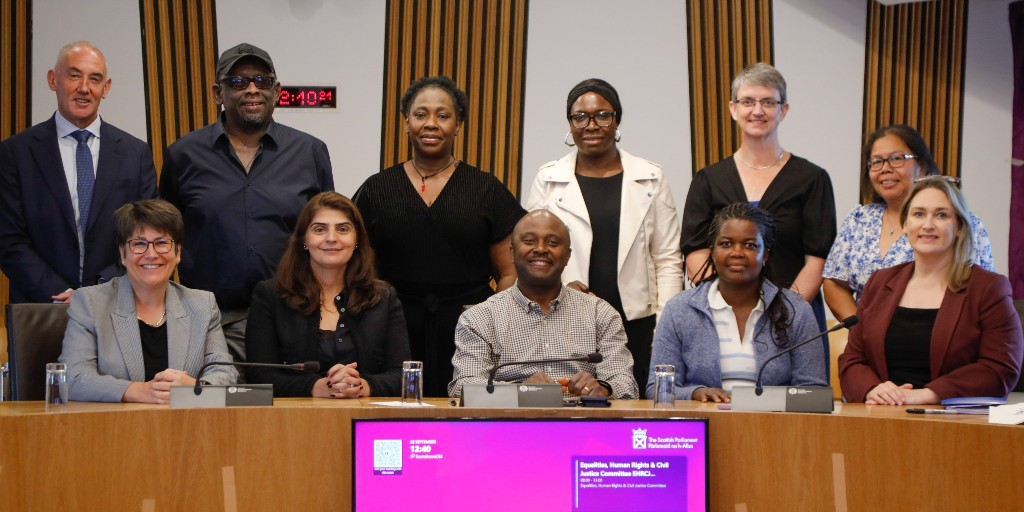
In the last year of this work with the Commission Advocating Rights for Minorities, the Committee was able to co-produce recommendations with the group. The Committee considers again that bringing this perspective to recommendations was of immense benefit.
Citizens provide a perspective that is unique and goes beyond the evidence that third sector intermediaries can provide. We would suggest that our successor committee look to strengthen this work and empower communities by continuing to involve citizens in scrutiny in a way that is meaningful. Working with a single group over time allowed for deeper scrutiny involvement - it may be worth exploring having long-term relationships with community groups as well as more targeted approaches to gathering lived experience in a participative way.
The Committee used a range of participative approaches in its work on asylum seekers, the Gender Recognition Reform Bill, British Sign Language and neurodivergence. These pieces of work were all much more effective as a consequence of being led and shaped by lived experience.
This evidence is often provided outwith the confines of formal meetings. The Committee has found it immensely beneficial to be able to be able to hold such sessions online to be able to hear from as broad a selection of society from across Scotland as possible.
Online sessions should not be the only model though. The Committee has also engaged with communities in other parts of Scotland in person. For example, in undertaking its rurality inquiry, it was immensely beneficial to be able to meet people in person in rural communities.
Whether it is online or in person, often this evidence can be the most impactful the Committee receives in the course of an inquiry and wherever possible members should ensure that they can attend these sessions.
More traditional evidence sessions will always continue, however, to be a core element of any scrutiny. In such sessions the Committee recognises the importance of hearing from a wide range of stakeholders, and encourages its successor committee to continue to seek diverse perspectives as part of its scrutiny work. In doing so, however, the Committee must ensure a balance of stakeholder perspectives in those it hears from.
The Committee has frequently found this session that the most effective formal evidence sessions have been conducted in a roundtable format. Taking evidence in this way has often been less adverserial and has resulted in more effective conversations at the table rather than a simple back and forth between members and witnesses.
One good example of this was in its final year of budget scrutiny when the Committee invited key stakeholders who had worked with the Committee throughout the session to reflect on progress made by the Scottish Government toward a human rights budget approach as well as the progress made by the Scottish Parliament toward a human rights approach to its scrutiny. Undertaking this as a conversation in a roundtable format resulted in much stronger evidence and much more organic conversation than could have emerged out of a traditional evidence panel.
The Committee would also stress the benefits to scrutiny of continuing to pursue issues throughout a session. The Committee considers that for a committee's work to be effective a committee must ensure that it follows up on an inquiry after its conclusion to ensure that the Scottish Government is delivering on the commitments it has made and outcomes for those to whom the inquiry related are improving.
For example, on its BSL inquiry the Committee followed up on its report with an evidence session with the Deputy First Minister, a Chamber Debate and a subsequent evidence session focussed on the impact of domestic abuse on Deaf survivors and their families.
The Committee would urge its successor to consider adopting this approach and perhaps to agreeing priorities at the start of the session that it will pursue through the remainder of the session.
In a similar vein, the Committee also reiterates the importance of post-legislative scrutiny. This has already been discussed in this report, but we must ensure that the legislation passed by this Parliament is having its intended effect or indeed being implemented at all.
Finally, the Committee also highlights the challenges inherent in the breadth of the Committee's current remit in being able to do justice to all of the key issues. In particular, the Committee has found it challenging to dedicate sufficient time to its scrutiny of civil justice matters. The Committee recognises the link between civil justice and the other areas of its remit, but would ask that the Bureau give careful consideration to how issues relating to civil justice can be most effectively scrutinised next session.
Possible issues for Session 7
Set out below are the key issues that this Committee has explored this session, which it would strongly recommend that a successor Committee return to. That is not to say that the Committee does not think that other areas of work undertaken by the Committee are not worthy of further examination, but in our view these areas below should be prioritised.
There are also two suggestions for work, which the Committee has not had the opportunity to undertake this session, but which were recommended by this Committee's predecessor committee.
Access to justice
Access to justice has been a key theme of the Committee’s work over the course of this session. In particular, the Committee has been concerned about the provision of civil legal assistance and the increasing challenges faced by some in finding a lawyer to take on a case.
In its civil legal assistance inquiry the Committee was presented with a picture of legal aid deserts, which are compromising people's ability to exercise their legal rights. These legal aid deserts relate to both geographic areas and areas of law including those relating to asylum seekers, immigration, welfare, housing and employment.
Perhaps most strikingly the Committee heard about the experience of women seeking legal assistance in relation to domestic abuse cases. The Committee was given the example of Grampian Women's Aid who are making 50 to 60 calls to find a legal aid solicitor. It is not a challenge unique to remote and rural areas. The Committee was also told that in domestic abuse cases across Scotland women are having to contact 30 to 50 solicitors before they can access advice.
The concerns the Committee heard about were alarming, but they were not new even if their extent is perhaps increasingly extreme. There has been an awareness of the need for significant reform of the civil legal assistance system for a long time. It is not something that has just emerged. Primary legislation should have been brought forward this session. It is welcome that the Scottish Government has been consulting on reform, but that consultation in and of itself is not sufficient. Legislative reform of civil legal assistance must be a priority for the next administration and the Committee strongly urges its successor to press that new administration for that legislation.
In its report, not only did the Committee call for primary legislation, but it also highlighted areas where it considered short-term changes could be made without the need for primary legislation. Specifically, the Committee highlighted the following areas:
Proceed with reforms to increase fees paid to legal practitioners;
Find more opportunities for traineeships to increase capacity;
Consider proposals to reduce administrative burdens and bureaucracy, thereby improving relations between SLAB and legal practitioners and creating an environment in which trauma informed approaches can thrive;
Broaden those eligible for civil legal assistance by increasing Advice and Assistance thresholds to match Civil Legal Assistance thresholds;
Moreover, all levels in advice and assistance and civil legal assistance should be increased in line with inflation since 2011;
Pursue reforms removing financial eligibility tests for civil protection orders and homelessness due to a breach of statutory duty cases;
Investigate options for ensuring legal aid is available without means-testing to a wider selection of domestic abuse cases;
Re-visit Regulation 15 with a view to enabling greater access to collective action;
Re-visit clawback provisions and contribution costs that might be discouraging people from pursuing proceedings.
The Committee also called on the Scottish Government to work with the Scottish Legal Aid Board to understand the extent of unmet need.
The Committee was pleased to see Regulations brought forward to increase fees for legal practitioners, which will hopefully encourage practitioners to stay in the sector. It is pleasing too to see that the Regulations were welcomed by legal practitioners.
While it is disappointing that more progress was not made on the Committee's other proposals for short-term changes, the Committee welcomed a letter from the Minister for Victims and Community Safety on 24 February 2026 setting out all the strands of work the Scottish Government is pursuing in order to deliver reform of civil legal assistance.
Primary legislation on civil legal assistance reform must not be delayed any further.
The Committee strongly recommends that its successor Committee continue to press the Scottish Government for action on both short-term changes and fundamental changes through primary legislation.
Given the likelihood of potential legislative activity in the next session, the successor Committee may wish to prioritise early, detailed scrutiny of any proposals brought forward. To support this work, the Committee recommends that its successor consider commissioning a People's Panel, or a similar public participation process, to gather informed public perspectives on priorities and trade‑offs in legal aid reform. Such input would strengthen the quality of scrutiny and help ensure that future reforms reflect public need and expectations.
Operation of the Public Sector Equality Duty in Scotland
The Committee agreed to undertake an inquiry into the operation of the Public Sector Equality Duty in Scotland in the context of the Scottish Government's proposed reforms to it.
More specifically, the Committee agreed to focus on the following themes:
the extent to which the Scottish-specific duties are delivering on the aims of the general duty and improving outcomes for people with protected characteristics;
the extent to which public authorities understand the terms of the aims of the general duty and the requirements of the Scottish-specific duties;
whether the proposed reforms will assist public authorities in embedding an equalities focus;
why the Scottish Government's original proposals have been changed; and
how effective the Equality and Human Rights Commission is at regulating public authorities’ performance against the PSED.
It became apparent to the Committee over the course of the inquiry that while a number of public authorities may be meeting certain compliance and process requirements in relation to the PSED, there is not nearly enough focus on delivering outcomes. The Committee called for a significant shift in culture to focus on outcomes as well as processes, ensuring that public bodies have a robust understanding of the PSED and the Equality Act 2010. The Committee urged the Scottish Government to work with public authorities to provide leadership to effect this culture change.
The Committee noted significant delays in the process of reform by the Scottish Government, but stressed that public authorities should not be waiting for the delivery of these reforms before pursuing improvements in how they deliver on the aims of the PSED and seek to improve outcomes for people with protected characteristics.
As in many other areas of the Committee's work, the Committee urged the Scottish Government to progress work on data collection, including examining national data collection. It noted that data collection is key to enabling public bodies to be able to design services and respond to challenges and that it is essential that public bodies are able to rely on robust, comprehensive and consistent data.
Amongst other things, the Committee explored in evidence whether public bodies understand how to balance the protections between different equality groups, and how to foster good relations.
The Committee recognised in its report that fostering good relations is a challenging concept to understand and to deliver upon. Nonetheless in the current climate of increasingly polarising debate it is one that is increasingly critical to deliver upon.
We live in an ever more polarised and unequal society where the rights of people with protected characteristics are increasingly under threat. The Committee urges its successor committee to follow-up on this work and ensure that not only is the Scottish Government responding to the recommendations of the Committee's inquiry, but it is demonstrating flexibility in its response to any new challenges as they emerge.
In concluding its inquiry the Committee noted its intention to return to this issue in the context of the EHRC's revised Code of Practice on Services, Public Functions, and Associations once that has been approved by the UK Parliament.
That revised Code is yet to be laid before the UK Parliament, far less approved. As such, the Committee has not been able to undertake this further work this session. For some members (Pam Gosal and Tess White) the judgment in For Women Scotland made the law clear and they would urge this Committee’s successor committee to consider the implications of the judgment without waiting for the revised Code. For one member (Rhoda Grant) some clarity has been provided by the judgment, but there is still a need for further clarity from the revised Code and as such consideration should be delayed until that revised Code has been approved. And for the remaining members (Karen Adam, Maggie Chapman, Paul McLennan and Marie McNair), the judgment has not provided the necessary clarity and they urge the successor Committee to consider this revised code once it has been approved. In all instances members would encourage a focus on how the law is being implemented and how the public sector is demonstrating leadership.
The Committee notes the importance of public bodies keeping policies and practice aligned with current law and statutory guidance, and stresses the importance of taking necessary action, including, where appropriate, training, to ensure compliance.
Asylum Seekers
As noted previously in this report, early in this session the Committee undertook an inquiry on asylum seekers in Scotland. While housing asylum seekers is a reserved matter, the Committee wanted to understand:
what rights asylum seekers in Scotland have
what public resources are available to asylum seekers
the experiences of people seeking, granted and refused asylum.
To get this understanding, the Committee focused its inquiry on:
the impact of current Home Office policy and legislation on asylum seekers in Scotland
the impact of the current system on local communities and race relations
the role of local and devolved government
the role of private contractors
the most effective use of public funding.
Between February 2023 and June 2023, the Committee held a number of evidence sessions and undertook engagement work. In particular, the Committee worked closely with Maryhill Integration Network and Refuweegee. The Committee published its report on 24 October 2023.
In concluding its inquiry the Committee noted that while immigration and asylum are reserved matters, there are ways the Scottish Government and local authorities can address some of the issues faced by asylum seekers in Scotland particularly with integration. Specifically, the Committee made the following recommendations for actions that could be taken:
Finding ways around the Illegal Migration Act to support trafficked people;
Advocating for a devolved national referral mechanism for the identification of victims of trafficking;
If, or when, the UNCRC Bill comes into force, it could be used to prevent mandatory scientific age assessment, forcibly subjecting children to MRI scans to determine their age, determining them an adult if they refuse consent;
A system where people pass initially through Glasgow where staff and support are concentrated before wider dispersal takes place;
Additional resource for third sector organisations who support asylum seekers
Resource to extend third party reporting centres for victims of trafficking and exploitation;
Access to concessionary travel for asylum seekers in Scotland;
Education and information for asylum seekers on their rights particularly in relation to health and mental health as well as language support during appointments;
Additional resource for local authorities for ESOL provision and interpreter services;
Additional courses for people to acquire counselling skills and recognise evidence of mental ill health;
Access to legal services.
Further to that report, the Committee wrote to the Minister for Equalities in February 2025, seeking an update on progress on the Committee's recommendations, in particular in relation to the provision of concessionary travel.
In its response the Scottish Government provided progress on extending free bus travel for people seeking asylum. Specifically, it highlighted funding being allocated to provide free bus travel for people seeking asylum who are not already eligible for concessionary travel. Moreover, it noted its intention to explore extending free bus travel to all people seeking asylum on a longer term basis.
Furthermore, the Scottish Government noted its ongoing engagement with UK Government on policy changes following repeal of parts of the Illegal Migration Act and continued support for victims of human trafficking. It also highlighted work to improve age assessment guidance for unaccompanied asylum‑seeking children and funding for third‑sector organisations supporting refugee integration and those at risk of destitution. The letter also details investment in ESOL provision, interpretation services, mental health support for asylum seekers and confirms ongoing development of a future Human Rights Bill.
Since the Committee concluded its inquiry and made these recommendations the debate around asylum seekers has become more polarised and pronounced. This is a very pressing issue and we would urge our successor committee to return to this issue early in the session.
Returning to the comments made earlier about the need to foster good relations between communities in the context of the PSED, it seems critical to the Committee that a successor committee examine how the tenor of the debate around asylum seekers can be changed and community relations improved.
Neurodivergence
This inquiry emerged out of the decision by the Scottish Government not to introduce a Learning Disabilities, Autism and Neurodivergence bill this session.
The Committee agreed to focus its attention on the experience of neurodivergent people in the following three areas:
Education
The workplace
Criminal Justice
The inquiry was informed by a series of formal roundtable sessions, but also informal engagement with disabled people's organisations. It was very important to the Committee that the inquiry was led by lived experience and the Committee was immensely grateful to all those who informed that work.
Committee members holding an informal session at the Salvesen Mindroom Centre
 (1))
The Committee was presented with an alarming picture of the experience of neurodivergent people in the three areas we focussed upon.
Although the Committee’s inquiry focused on the experience of neurodivergent people in education, the workplace and criminal justice, the Committee also examined the experience of obtaining a diagnosis and post diagnostic support. The Committee was presented with an alarming picture of the experience of neurodivergent people in seeking a diagnosis and thereafter in education, the workplace and the criminal justice system.
The Committee recognised in its report the significant challenge presented by the unprecedented numbers of people who have either been diagnosed or are seeking a diagnosis for a neurodivergent condition.
The challenges that this presents are significant and it is vital that the next administration prioritise this issue next session. The next administration must work closely with those with lived experience to develop legislative and non-legislative responses to these challenges.
In the inquiry it became apparent that there is a significant gap between what the Committee was told about the policies in place to support neurodivergent people and the lived experience of how those policies are realised. The next administration needs to speak to neurodivergent individuals to understand the extent of this discrepancy and how it can be overcome.
The Committee also heard about the importance of a diagnosis. The Committee recognised the value of a needs based approach, but concluded that this cannot be a replacement for a diagnosis and urged the next administration to develop a long term strategy with long term funding to ensure we have the workforce needed to be able to respond to the demand for diagnoses.
The Committee also called for a fundamental change to society. It stressed that having a neurodivergent condition should not be seen as a deficit.
Neuro-affirming practice should not be treated as optional good practice, but as a core part of effective public service design. A system that understands distress, communication and difference properly is better able to intervene early, reduce harm, and support better outcomes across education, health, employment and justice.
In the short time we have had this session we have identified key areas that must be pursued next session. Change will not happen, however, without much further work. We urge our successor committee to prioritise this work at the beginning of next session and build on the work of this inquiry, holding the next administration to account for responding to the needs of neurodivergent people in Scotland.
Human Rights
Human Rights bill
Of particular concern to the Committee has been the failure on the part of the Scottish Government to introduce a Human Rights bill this session.
For much of this session, and on a wide variety of issues, the Scottish Government has heralded a Human Rights bill as their flagship response to challenges in relation to human rights.
It was envisaged that the bill would bring international human rights treaties into Scots law and make them enforceable.
A Human Rights bill was part of the 2023-24 Programme for Government and was set to be introduced before summer recess 2024.
The Cabinet Secretary for Social Justice, Shirley-Anne Somerville MSP explained in a letter to the Committee in September 2024 that the Scottish Government was still committed to taking forward the Human Rights Bill, but not until the next Parliamentary session.
Considerable stakeholder concern was expressed about the decision not to introduce a bill. For example, Human Rights Consortium sent a letter to the First Minister on behalf of over 100 organisations which argued that the decision was “highly regrettable” and a “dismissal by Scottish Government of the very real and pressing human rights issues facing people in Scotland.”
Similarly, the Chair of the Scottish Human Rights Commission, Professor Angela O’Hagan, stated that:
Abandoning this Bill denies people access to justice to ensure their human rights are fully realised, from a safe home to decent food and good health and social care.1
In July 2025 the Scottish Government confirmed its intention to introduce a bill next session and published a discussion paper to inform it.
In December 2025 the Committee wrote to the Minister for Equalities expressing its "sincere disappointment" in the failure to introduce a bill this session and seeking reassurance that there would be no further delay next session.
The Minister responded in January 2026 confirming the Scottish Government's commitment to introduce a human rights bill if returned.
A majority of the Committee urges its successor committee to pursue the introduction of a human rights bill next session as a matter of priority.i
Getting rights right report
The former Equalities and Human Rights Committee, in session 5, published Getting Rights Right: Human Rights and the Scottish Parliament, on 26 November 2018.
In short, the Committee called on the Scottish Parliament to be an international leader in human rights and set out a range of recommendations to achieve this.
The inquiry developed over growing international consensus that parliaments must take a more active role in the promotion and protection of human rights. Parliaments have a central role as ‘guarantors’ of human rights, because they have the power to legislate, hold national debates, and scrutinise the work of government.
There was a sense at the end of 2016 that the human rights landscape was changing because of:
Brexit
a proposal for the UK to withdraw from the European Convention on Human Rights
a proposal to replace the Human Rights Act 1998 with a British Bill of Rights.
The Scottish Human Rights Commission and civil society groups were also calling on the Parliament to be a ‘guarantor’ of human rights.
The inquiry had two phases:
Phase 1 – the Committee sought written briefings on the scrutiny of human rights in other legislatures in the UK. It also looked at international comparisons of best practice in the monitoring and scrutiny of human rights.
Phase 2 – the Committee sought views from the people of Scotland and interested groups. Representations were made through written submissions, oral evidence to the Committee, and focus groups of people with lived experience. The views of other Scottish Parliamentary Committees were also sought.
The Committee made 40 recommendations. Most of these were aimed at the Committee itself, but there were also recommendations to the Scottish Parliament, and to the Scottish Government.
It set out a ‘roadmap’ and had an action plan to take the recommendations forward.
The recommendations were extremely wide‑ranging, involving the Parliament, all subject committees, the Scottish Government, and the SHRC.
Some recommendations required systemic changes, such as new scrutiny structures, new monitoring frameworks, cross‑committee culture change, which tend to progress more slowly.
Other recommendations required other bodies taking action and could not be advanced by the Committee.
The Committee’s remit was extended in Session 6 to include Civil Justice. This broadened its scope, but with the same number of members.
Much of the Committee’s time in Session 6 has been taken up by legislative scrutiny as well as areas of inquiry chosen by the Committee.
The Getting Rights Right Action Plan was ultimately disrupted by the turnover of committees in Session 6. At the start of Session 6, the Committee did not revisit the Action Plan, so progress has been intermittent.
Despite this, there has been some progress given that the remit of human rights is firmly embedded in the Committee.
The Committee has made some progress on the action plan, for example:
There has been a continued focus on human rights budgeting.
The Committee has undertaken work on international treaty monitoring, including evidence sessions on CESCR periodic review.
There have been evidence sessions on delays to legislation which demonstrates the Committee asserting a stronger human rights voice.
There has been consideration of a range of human rights issues such as asylum seekers and refugees, children’s rights, and minimum core obligations.
Human Rights scrutiny
Reflecting on that report and building on the work that the Committee has undertaken this session, the Committee urges not just this Committee, but parliamentary committees more generally to apply a human rights lens to their scrutiny work in the next session.
As noted earlier, the Committee has applied a human rights approach to its budget scrutiny and it would encourage its successor committee and committees more generally to adopt this approach.
The Committee would also highlight the sessions it has held on the implementation of the International Covenant on Economic, Social and Cultural Rights (ICESCR).
ICESCR is one of the core UN human rights treaties. Ratified by the UK in 1976, it guarantees a wide range of rights including the right to work, to an adequate standard of living (including food, housing and clothing), to health, to education, and to social security. These rights apply to everyone without discrimination, and States parties have a legal obligation to respect, protect, and fulfil them.
The Committee on Economic, Social and Cultural Rights (CESCR) is the expert UN body responsible for monitoring implementation of the ICESCR. As part of its review cycle, States submit periodic reports. Civil society organisations, national human rights institutions (NHRIs), and devolved governments can submit shadow or supplementary reports. The Committee’s Concluding Observations are authoritative, setting out recommendations and concerns based on all the evidence received.
The Committee held a further session in February 2026 with the Minister for Equalities with a focus on the Scottish Government's High Level Action Plan, published in November 2025, which sets out how it intends to respond to CESCR’s Concluding Observations. The session also looked at the Scottish Government's forthcoming digital Human Rights Tracker, which has subsequently been published.
The Committee would urge its successor committee to continue with these sessions on an annual basis and consider how it can use the Human Rights Tracker tool and the Action Plan to measure the Scottish Government's progress in responding to the concluding observations.
The concluding observations have implications for a wider variety of subject areas. With that in mind, we would urge all committees to reflect on these observations and consider how they could use the Tracker tool to measure the Scottish Government's progress against them in areas within their remit.
In undertaking any work on CESCR, the Committee would urge its successor committee and committees more generally reflect on work done by the Committee this session on minimum core obligations.
'Minimum core', in the context of human rights, is intended to be a baseline of social, economic and cultural rights that every state should implement immediately.
Examples of minimum core are:
ensuring people are not deprived of essential food
ensuring access to water
ensuring access to basic shelter, or temporary accommodation where requested
providing free primary education for everyone
having a national public health strategy.
If the government does not provide rights to a minimum core level, it is in violation of its legal obligations.
The Committee urges its successor committee to again reflect on minimum core obligations in the context of its scrutiny work next session.
The Committee also urges other committees to adopt this approach and consider how commitments made this session in terms of rights to access food and housing, for example, are being delivered upon by the next administration.
It must be ensured that commitments are met, and committees should not neglect their responsibility to ensure that the next administration is fulfilling these commitments.
Role of the SHRC
The Scottish Human Rights Commission (SHRC) is Scotland’s National Human Rights Institution (NHRI). It is independent of the Scottish Parliament and Scottish Government.
It was set up under the Scottish Commission for Human Rights Act 2006 (as amended). The SHRC is accountable to the people of Scotland through the Scottish Parliament and is accredited as an A-Status National Human Rights Institution within the United Nations (UN) human rights system
The SHRC has a general duty to:
Promote human rights by raising awareness and understanding; and
Encourage best practice in relation to human rights.
This session, the Committee has worked closely with the SHRC both formally and informally—from supporting the Committee’s human rights budgeting work to providing evidence for scrutiny of legislation such as the Children (Withdrawal from Religious Education and Amendment of UNCRC Compatibility Duty) (Scotland) Bill.
The Committee holds annual sessions with the SHRC on its annual report, but in addition it has heard evidence on its wider work, including research on rurality that has directly informed and prompted further work by the Committee.
In June 2025, Parliament accepted the recommendation of the SPCB Supported Bodies Landscape Review Committee not to create new office-holders of the Scottish Parliament. This was accepted alongside the recognition that with the appropriate powers and resources, the SHRC as Scotland's NHRI would be even better equipped to protect the rights of those groups, as well as to hold duty-bearers in Scotland to account for the realisation of human rights more broadly. Specifically, the Committee stated that it "believes there is a case for a wider review of the remit and powers of the SHRC".
The SHRC wrote to this Committee encouraging it to recommend to its successor committee to follow-up on this recommendation.
The Committee welcomes the suggestion to follow-up on a wider review of the remit and powers of the SHRC and urges its successor committee to do so and consider how the SHRC can perform its role as Scotland’s NHRI most effectively.
The Committee also encourages its successor committee to consider how it can work as effectively as possible with the SHRC in the interests of good scrutiny while still maintaining its role in holding the SHRC to account for its performance.
Conversion Practices
Petition PE1817, calling for the ending of conversion practices, was lodged in July 2020. At its first meeting (23 June 2021) of this session, the Committee agreed to undertake an inquiry into conversion practices.
On 25 January 2022 the Committee published a report expressing support for a fully comprehensive ban (without imposing any restrictions on “ordinary religious teaching or the right of people to take part in prayer or pastoral care to discuss, explore or come to terms with their identity in a non-judgmental and non-directive way”).
The Scottish Government committed to bring forward legislation, as far as practicable within devolved powers, by the end of 2023.
This legislation did not materialise and the Committee wrote to the Scottish Government in February 2025 seeking an update.
The Minister for Equalities replied to the Committee in May 2025 indicating that the Scottish Government was working with the UK Government in the development of a Bill that:
applies across all settings;
is trans inclusive;
protects all ages; and
does not include any exemption for consent.
However, the Minister indicated that the Scottish Government would introduce a bill in the Scottish Parliament if no collaborative approach could be agreed.
We would urge our successor Committee to follow-up on this issue next session to see what progress is being made in tackling it.
Moreover, some members of the Committee would urge the successor committee to press the Scottish Government to prioritise bringing forward legislation.
Non implementation and non introduction of legislation
On 5 November 2024, as part of its work programme discussion, the Committee agreed to undertake some post-legislative scrutiny and, in particular, to explore the impact of the delay of the implementation of all or some provisions within the following three Acts:
Further to those sessions the Committee wrote to the Scottish Government, receiving a joint response from the Minister for Equalities and Minister for Victims and Community Safety in September 2025.
That letter contains a detailed account of progress in implementing these outstanding provisions. It was clear, however, from the letter that there remains a considerable amount of work still to be done to ensure the implementation of these provisions.
In that letter, the Ministers committed to quarterly updates. Those updates were not forthcoming, and the Committee wrote to the Scottish Government for an update on all three pieces of legislation, but with a specific focus on the FGM Act, including a request to see the draft statutory guidance on FGM.
The Scottish Government provided the Committee with that draft guidance along with an update on progress on the implementation of all three Acts. Once again, it is clear that there is still a lot of work to be done before the provisions can be implemented.
The Committee is deeply disappointed with the lack of progress in implementing this legislation, in particular in relation to FGM. The Committee strongly recommends that its successor committee continue to monitor progress in the implementation of these provisions and ensure that as a key stakeholder it is provided with the regular updates that the Scottish Government committed to providing. Moreover, we urge our successor committee to press the Scottish Government on ensuring that there is no further undue delay in the implementation of the Acts.
Post-legislative scrutiny of the British Sign Language (Scotland) Act 2015
Given that a decade had passed since the British Sign Language (Scotland) Act 2015 was enacted, the Committee agreed at its meeting on 4 February 2025 to hold a short inquiry considering actions taken by the Scottish Government and public authorities listed under the Act to tackle barriers faced by BSL users in Scotland. Specifically, the Committee agreed to focus on:
Whether the BSL Act, the current BSL Plan and listed- authority plans are improving the lives of BSL users; and
What changes could be made in the shorter and longer term to improve the lives of BSL users.
The Committee launched a call for views and took evidence from representatives of Deaf organisations (including BSL users), academics, authorities listed under the Act, and the Deputy First Minister.
In addition to formal evidence taking, the Committee held two informal engagement sessions (one online and one in-person) with BSL users to learn about the lived experience and priorities of Deaf and deafblind people in Scotland.
The Committee's report was published on 27 September 2025. The report found that the Act had brought significant benefits to BSL users in Scotland, including through increased visibility of the language, improved access to services, and greater empowerment of the Deaf community. However, progress had been uneven and challenges remained including through a shortage of qualified interpreters. Specific issues were raised in the context of policy areas including education, employment, health, and justice. These topics and others were further explored in a committee debate on the report on 11 December 2025.
The Committee also agreed to take evidence on the Sign LOUD report: Perspectives on domestic abuse and communication issues and the impact on deaf families (published in December 2025) and this session took place on 3 March 2026.
The Committee found this to be a particularly constructive piece of post-legislative scrutiny which helped bring added momentum to the ongoing implementation of the Act's provisions in order to help further reduce barriers encountered by BSL users. We recommend that our successor committee maintains this focus by taking evidence on progress towards full realisation of the Act's intentions at least once in the next session. It is essential that BSL users themselves are consulted as part of any future work on this topic.
Rurality
The Committee agreed at its meeting on 13 May 2025 to undertake an inquiry on human rights, equalities and access to services in rural areas of Scotland and that the Scottish Human Rights Commission’s Report on Economic, Social and Cultural Rights in the Highlands and Islands would form a key reference point for this work.
The Committee's report highlighted the interconnected nature of many of the additional barriers faced by people living in rural communities. While specifics will vary depending on locality, the report noted an increased cost of living and a lack of affordable housing in many rural communities. Other inequalities related to access to healthcare, education, employment, training, justice and legal advice, all of which can help accelerate depopulation and risk the long-term sustainability of rural communities.
The Committee also found that local people are often best placed to come up with local solutions and called for sustainable and secure long-term investment for third sector partners to support their essential work.
Members visiting Blairgowrie .jpg)
While the SHRC report on Economic, Social and Cultural Rights in the Highlands and Islands provided a helpful starting point for the inquiry, it did not consider other rural parts of Scotland. The SHRC has recently confirmed that it will produce a separate report on Economic, Social and Cultural Rights in the South of Scotland which will be published in summer 2026.
Given the broad range of issues considered and their interconnected nature, the Committee recognises that other committees have a key role to play in scrutinising policy developments within their own remits. However, this committee has a key role to play in ensuring that consideration of human rights is not lost sight of in the context of rurality. We recommend that our successor continues to monitor progress, or lack thereof, towards the full realisation of rights in rural areas. The publication of the SHRC report on the South of Scotland is expected to provide a key opportunity to further progress this work.
Issues not explored this session
As noted at the outset of this section, there are two outstanding issues, which were recommended for further scrutiny by our predecessor committee, which we have not undertaken any substantive work this session, but which we would recommend our successor committee return to.
Firstly, the Committee has not pursued work this session on Gypsy/Travellers. In the session 5 Equalities and Human Rights Committee's legacy report it highlighted the long-standing interest of that Committee and its predecessor committees in the lives of Gypsy/Travellers in Scotland.
It recommended that its successor Committee keeps a focus on this area by monitoring the implementation of the Scottish Government and COSLA’s joint action plan to ensure it impacts positively on the lives of Gypsy/Travellers in Scotland.
The Committee urges its successor to return to see what progress has been made in the intervening years, particularly in the context of the independent report commissioned by the Scottish Government "Twentieth century policies affecting Gypsy/Traveller communities in Scotland: archival research" and the apology made by the Scottish Government in June 2025 for the "Tinker Experiment".
Last session Parliament passed the Age of Criminal Responsibility (Scotland) Bill, which raised the age of criminal responsibility from 8 to 12.
During the Bill’s passage there was debate about increasing the age of criminal responsibility further. In response, the Minister for Children and Young People, Maree Todd, announced on 29 April 2019 that an Advisory Group would be established to review the operation of the Age of Criminal Responsibility (Scotland) Act 2019 and to consider potential future ages of criminal responsibility in Scotland. At the time of our predecessor committee's legacy report the Advisory Group had yet to report and it recommended that its successor committee should monitor the progress of the Act’s implementation and the outcomes of the Advisory Group.
The report of the Advisory Group was published in December 2025. In that report, the advisory group concluded that raising the age of criminal responsibility further, potentially to 14, 15, or even 16, was possible, and would align Scotland with jurisdictions at the leading edge of international standards, enhance the rights of children, and reinforce Scotland’s position as a leader in progressive, rights respecting policies.
In their response, Scottish Government Ministers recognised the need to carry out a full public consultation with a view to ascertaining views on an incremental future increase in the Age of Criminal Responsibility. Moreover, it concluded that such a consultation would be more appropriately conducted in session seven.
The Committee would encourage its successor committee explore this issue further and ensure that the Scottish Government meets its commitment to consult on an incremental future increase in the Age of Criminal Responsibility.
Conclusion
As we now come to the final days of this session and reflect on the work we have done and our ambitions at the beginning of this session, it is disappointing to reflect on so many areas of work where progress has been delayed.
Commitments by the Scottish Government to introduce legislation on Learning Disabilities, Autism and Neurodivergence, Human Rights, Civil Legal Assistance and Conversion Practices have all failed to be met. In addition, in the course of the Committee's work on the non-implementation of legislation passed by the Parliament, it is apparent that there are bills dating back as far as six years with provisions still to be implemented.
More generally, we would reflect on a session that began at the tail end of Covid with hopes for a better world emerging out of it. As we now conclude this session, from the perspective of the remit of this Committee at least, it is difficult to see signs of that better world.
We would urge our successor to continue to hold the Scottish Government to account to ensure it brings forward policies and legislation to contribute to a more equal and less polarised society. We would particularly encourage our successor committee to hold the Scottish Government to account for delivery of its commitments to bring forward legislation that it failed to deliver on this session as well as its commitment to fully implement the legislation we have highlighted that remains unimplemented since session 5.
The Committee considers however, that it has been able to undertake effective work this session, which should put a successor committee in an advantageous position as it begins work in these areas. That work has been most effective when shaped by and led by lived experience and we would encourage our successor committee to pursue its work in a similar fashion.
Fundamentally, we consider that while the outlook may be challenging in those areas covered by this Committee's remit, the Committee's work has shown that centring work around lived experience can still lead to real and meaningful progress and this must be a lesson we all take forward.
Sources
Letter from the Chair of the Scottih Human Rights Commission on a Human Rights bill for Scotland. (2024, November 20). Retrieved from <a href="https://www.parliament.scot/chamber-and-committees/committees/current-and-previous-committees/session-6-equalities-human-rights-and-civil-justice-committee/correspondence/2024/human-rights-bill-for-scotland-20-november-2024" target="_blank">https://www.parliament.scot/chamber-and-committees/committees/current-and-previous-committees/session-6-equalities-human-rights-and-civil-justice-committee/correspondence/2024/human-rights-bill-for-scotland-20-november-2024</a> [accessed 13 2026]